
From ancient Greek mythology to modern feminist icon — the complete guide to Medusa tattoo meaning, deep symbolism, every style, and the things no other blog will tell you.
Medusa is one of the most recognized tattoo designs in the world right now. Walk into any top tattoo studio in New York, Los Angeles, or Chicago — and chances are, someone just asked for a Medusa piece.
Who Was Medusa? The Greek Mythology Origin You Need to Know
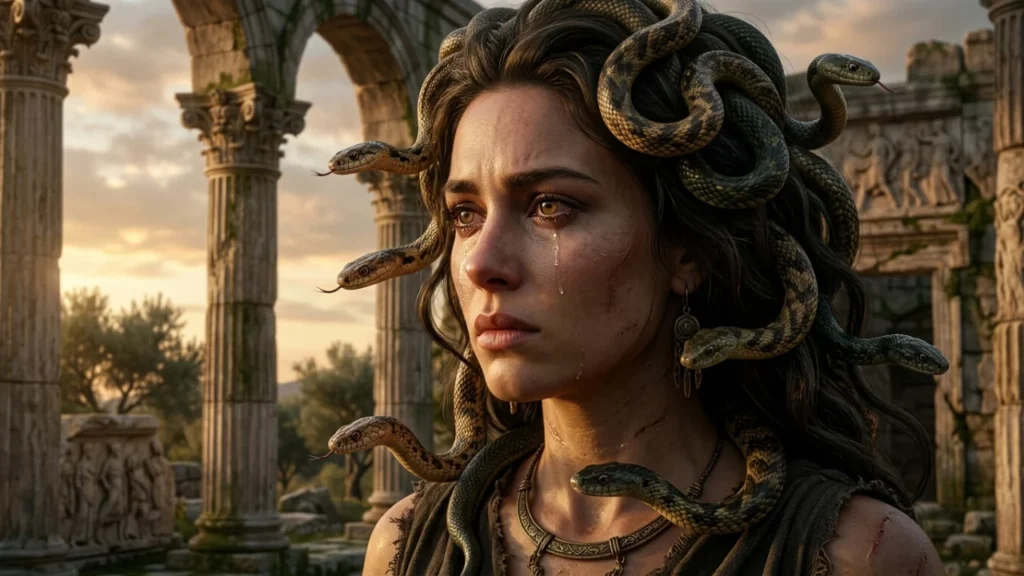
Most people know the surface story. Medusa was a Gorgon — a creature with snakes for hair whose gaze turned anyone who looked at her directly into stone.
But that’s the end of her story. Not the beginning.
From Beautiful Priestess to Feared Gorgon
In the original Greek mythology, Medusa was not born a monster. She was a mortal woman — and by most ancient accounts, strikingly beautiful. She served as a priestess of Athena, goddess of wisdom, in her sacred temple.
Then came Poseidon, god of the sea. He assaulted Medusa within Athena’s own temple. What happened next reveals something deeply disturbing about how ancient societies handled such crimes.
Athena did not punish Poseidon. She punished Medusa. She transformed Medusa’s glorious hair into writhing serpents, made her face so terrible that any man who gazed upon her would be turned to stone, and cursed her to live as an outcast on the edge of the world.
The myth of Medusa appears in Hesiod’s Theogony (circa 700 BC) and Ovid’s Metamorphoses. Ovid’s version (Book IV) explicitly describes Medusa as once having beautiful hair and being desired by many — before Poseidon’s assault and Athena’s punishment transformed her.
Source: Ovid, Metamorphoses, Book IV — Perseus’ account of Medusa’s origin.
This is the story that millions of people are putting on their skin. Not the monster — the woman behind the monster.
Perseus, the Gorgon Sisters, and Medusa’s Blood
Perseus was sent to behead Medusa. He used a polished shield as a mirror — looking at her reflection rather than directly — to avoid her petrifying gaze. He succeeded.
But here is what most blogs never mention: from Medusa’s severed neck, two beings were born — Pegasus, the winged horse, and Chrysaor, a giant. These were Poseidon’s children, carried within her throughout her cursed existence.
Even in death, Medusa gave life. Even after everything was taken from her — beauty, freedom, her human form — something magnificent still emerged from her.
That is why her symbolism runs so deep.
The Apotropaic Symbol — Ancient Protection Magic
Ancient Greeks and Romans did not only fear Medusa. They used her.
Her face — called the Gorgoneion — was engraved on shields, military armor, city gates, temples, and coins across the ancient world. The belief was simple: her image would ward off evil, protect soldiers in battle, and repel enemies.
Athena herself wore the Gorgoneion on her Aegis shield. The goddess who cursed Medusa then weaponized her face as the ultimate protective emblem.
📌 Key Term
Apotropaic (from Greek apotrepein — “to ward off”) refers to objects, symbols, or rituals believed to protect against evil forces. The Medusa image is one of antiquity’s most powerful apotropaic symbols — and tattoo wearers today are continuing a 2,700-year-old tradition.
✦ ✦ ✦
Must Visit: ETA Meaning: Understanding Its Full Significance in Business, Shipping & Daily Life
Medusa Tattoo Meaning: Deep Symbolism, Layer by Layer
What does a Medusa tattoo mean? The honest answer: it depends on who is wearing it. But there are core symbolic threads that run through almost every interpretation.
🛡️
Protection
The oldest and most universal meaning. Her image has guarded people for over 2,700 years.
🔥
Feminine Power
Defiance, autonomy, and the refusal to be silenced, shamed, or controlled.
🌀
Transformation
Rising from pain into power. A before-and-after marker for major life shifts.
💜
Survival & Healing
Chosen by trauma survivors worldwide as a symbol of reclaiming their story.
⚖️
Duality
Beautiful and dangerous. Soft and fierce. Complex and real — just like people.
⚡
Rebellion
A figure who defied gods. The ultimate symbol for nonconformists and rule-breakers.
Feminine Power and the Feminist Reinterpretation
In modern culture, Medusa has become a feminist icon. The shift happened gradually — through academic writing, social media, and the post-#MeToo movement — and then all at once.
The core reframe is this: Medusa was not the villain. She was the victim. She was cursed for something done to her, then hunted and killed, and then her power was stolen and used by others.
Sound familiar?
Women who have faced assault, injustice, or systemic punishment for things beyond their control see their own story in hers. That is why the Medusa tattoo for women has exploded in the last decade. She is not a warning. She is a mirror.
Even the luxury brand Versace uses Medusa as its logo — a deliberate choice by founder Gianni Versace to represent “power, beauty, and dangerous allure.”
Survival, Healing, and the SA Survivor Connection
Why is the Medusa tattoo associated with sexual assault survivors? Because her story is their story.
She was assaulted. She was blamed. She was punished. And she was eventually hunted down. But she did not disappear without leaving a mark — she turned those who came for her to stone. She gave birth to Pegasus. Her blood became a weapon.
For survivors, the Medusa tattoo symbolism goes beyond art. According to a 2020 study published in Body Image journal, tattoos can serve as powerful therapeutic tools for trauma survivors — offering a sense of control over the body, a visible narrative of healing, and a reclamation of physical autonomy.
UK-based tattoo artist Ruby Rose has spoken extensively about this. She notes that the tattoo represents survival, strength, and overcoming adversity — and that for many clients, the act of choosing and receiving this design is itself part of the healing process.
Studio Aureo (Rome) reports completing approximately 30 Medusa tattoos in a single six-month period — with clients spanning multiple countries, backgrounds, and reasons. Many cited personal trauma as a motivation, while others chose it purely for its mythological and aesthetic resonance.
Source: Studio Aureo Tattoo Blog, 2024.
Transformation and Rebirth — The Serpent Skin Metaphor
There is a reason Medusa’s hair is made of serpents. Snakes are one of the oldest symbols of transformation in human culture — because they literally shed their skin and emerge renewed.
A Medusa snake hair tattoo carries double transformation symbolism. The woman transformed by injustice. The serpents representing continuous renewal. Together, they create one of the richest symbols of personal evolution in all of body art.
Many people choose this design to mark a specific turning point: the end of an abusive relationship, recovery from addiction, a cancer diagnosis overcome, or simply the decision to stop living for others’ approval.
Duality — Beauty, Danger, and Hidden Strength
Medusa is simultaneously the most alluring and the most deadly figure in Greek mythology. She captivates and destroys in the same breath.
This duality resonates with people who feel they carry contradictions within themselves. Those who are soft and fierce. Gentle and guarded. Loving and self-protective.
The weeping Medusa tattoo — a specific interpretation showing tears on her face — takes this further. It says: even the strongest among us carry grief. Even the fearsome cry. That vulnerability is not weakness. It is humanity.
Rebellion and Nonconformity — A Symbol for Rule-Breakers
Medusa defied a goddess. She existed outside society’s accepted spaces. She was considered too dangerous, too powerful, too much — and she was eliminated for it.
That story has enormous resonance in American tattoo culture, where body art has long been an act of self-definition against mainstream norms. The Medusa tattoo as rebellion symbol speaks to anyone who has been told they are too much, too loud, too complicated — and chose to remain exactly as they are.
✦ ✦ ✦
Medusa Tattoo Styles: Which One Matches Your Story?
The style you choose changes everything. The same subject can feel fierce, ethereal, dark, or quietly personal depending on technique. Here is a breakdown of the most popular Medusa tattoo styles — and what each one communicates.
| Style | Key Features | Emotional Tone | Best Placement |
|---|---|---|---|
| Realistic Portrait | Hyper-detailed, expressive eyes, textured snakes | Raw power, intensity, confrontation | Back, thigh, chest |
| Neo-Traditional | Bold outlines, vibrant color, modernized classic look | Bold identity, artistic pride | Upper arm, thigh |
| Blackwork / Gothic | High contrast, dramatic shadows, dark atmosphere | Mystery, grief transformed | Forearm, ribs, sleeve |
| Minimalist / Fine Line | Clean single lines, subtle detail, discreet | Quiet power, private meaning | Wrist, ankle, collarbone |
| Geometric / Abstract | Sacred geometry, dual-face compositions, structured forms | Modern identity, philosophical depth | Forearm, shoulder, sleeve |
| Floral Medusa | Flowers woven into snakes, softened intensity | Fierce beauty, tenderness over trauma | Shoulder, thigh, ribcage |
Realistic Portrait — The Full Power Statement
A realistic Medusa tattoo is the boldest choice. When done by a skilled artist, it feels like she is actually looking at you from the skin. Every snake has texture. Every eye has emotion.
This style demands a large canvas — the back, thigh, or chest — and an artist with genuine portrait experience. The emotional payoff is unmatched when executed well.
Minimalist and Fine Line — Power in Restraint
Not every statement needs to be loud. A fine line Medusa tattoo on the wrist or collarbone carries the full weight of the mythology in a whisper.
This style is growing rapidly, especially among first-time tattoo clients and those who prefer discreet body art in professional environments. The meaning is identical — the volume is simply turned down.
The Dual-Faced Medusa — Beauty and Monster Combined
One design most blogs never properly explain: the dual-faced Medusa — one side depicting her original mortal beauty, the other her transformed Gorgon form.
This is perhaps the most symbolically complete interpretation. It holds both truths at once: who she was, and what was made of her. For many wearers, it reflects their own duality — the person before a painful chapter, and the person who emerged from it.
Color vs. Black & Grey — What Your Choice Says
Color Medusa tattoos use vibrant palettes to amplify specific meanings:
- Red accents — passion, rage converted into power
- Green serpents — nature, renewal, the life-giving snake
- Gold/yellow tones — divine wisdom, Athena’s energy, sacred protection
- Deep blue — Poseidon’s ocean, depth, emotional complexity
Black and grey Medusa tattoos age more gracefully, deepen in shadow over time, and carry a timeless, dramatic quality that suits the Gothic and realistic styles especially well.
✦ ✦ ✦
Medusa Tattoo Placement Guide: Where You Put It Changes Everything
Placement is not just a practical decision. In tattoo culture — especially with symbolic designs like Medusa — where you choose to put the tattoo carries its own meaning.
🦵 Thigh
Private but powerful. Hidden strength you carry with you everywhere. Chosen most often by survivors who want meaning without constant visibility.
💪 Forearm
Visible, bold, a daily reminder to yourself and others. Says: “I am not hiding who I am.” Maximum confidence placement.
🔙 Back
The ultimate shield. Medusa literally guarding your back. Best canvas for full realistic portraits. Protective symbolism at its most literal.
❤️ Chest
Over the heart. Closest to your core. The most personal placement — reserved for meanings that live deep inside you.
🦴 Ribs
Hidden strength that breathes with you. Intimate, personal, and deeply private. It moves when you breathe — it is alive.
🤝 Shoulder / Upper Arm
Strength made visible. Easy to show or cover depending on context. The versatile choice for professional environments.
✦ ✦ ✦
What Competitors Don’t Tell You About Medusa Tattoos
This is where most guides stop. This is where we keep going.
Medusa and the Male Gaze — The Feminist Theory Angle
There is a fascinating layer of feminist literary theory around Medusa’s petrifying gaze that almost no tattoo blog addresses.
Think about it: throughout history, women have been subjected to the male gaze — looked at, assessed, objectified. Medusa literally reverses that dynamic. She is the one who looks. And the one who looks at her is destroyed.
French feminist philosopher Hélène Cixous wrote a landmark 1975 essay titled “The Laugh of the Medusa” — reclaiming Medusa as a symbol of feminine creative power and freedom from patriarchal control. This is not fringe theory. It is widely taught in American university literature and gender studies programs.
When someone in post-#MeToo America gets a Medusa tattoo, this is often the unspoken subtext: I am no longer the one being turned to stone.
Medusa Paired With Other Symbols — What Each Combination Adds
The meaning of a Medusa tattoo design can be expanded or refined by the symbols surrounding her:
- Medusa + Moon — feminine cycles, intuition, mystery, divine feminine energy
- Medusa + Flowers — beauty layered over trauma, growth from pain
- Medusa + Skull — survival over death, mortality acknowledged and defied
- Medusa + Geometric shapes — structured power, modern philosophical depth
- Medusa + Pegasus — the full mythology: from her destruction came something beautiful
- Medusa + Broken chains — liberation, freedom from past bondage
Is a Medusa Tattoo Only for Women? The Real Answer
Medusa tattoos are not exclusive to women. Anyone can wear her.
For men, the Medusa tattoo meaning often centers on protection, duality, and complexity. Some choose her to represent a powerful woman in their life. Others connect with the themes of transformation and survival on a personal level, regardless of gender.
Within the LGBTQ+ community in America, Medusa has also become a meaningful symbol — representing defiance against systems that punish people for who they are, and the reclamation of an identity others tried to destroy.
How to Choose the Right Artist for a Medusa Tattoo
Medusa is one of the most technically demanding tattoo subjects. The design typically requires:
- Strong portrait skills for facial expression and emotion
- Expertise in rendering organic textures (scales, skin, hair)
- Compositional experience with complex mythological scenes
- Understanding of symbolic tattoo work and its emotional weight
Always review an artist’s portfolio for previous portrait and mythological tattoos — not just their general work. Ask specifically whether they have completed Medusa pieces before. A great general tattoo artist is not automatically a great choice for this level of detail.
✦ ✦ ✦
Frequently Asked Questions
What does a Medusa tattoo mean?
A Medusa tattoo means protection, feminine power, transformation, survival, and resilience. Rooted in Greek mythology, Medusa was a priestess cursed into a Gorgon after being victimized.
Why is the Medusa tattoo for SA survivors?
Medusa’s story directly mirrors the experience of many sexual assault survivors. She was assaulted by Poseidon, then punished by Athena — blamed for something done to her. This narrative of victimization followed by injustice resonates powerfully.
Was Medusa evil or a victim?
Based on the original mythology, Medusa was a victim. She was a devoted priestess of Athena who was assaulted by Poseidon and then punished by the goddess she served. Later classical writers — particularly Ovid in Metamorphoses — explicitly frame her as a figure of beauty and sorrow, not malice.
What does a jellyfish tattoo mean?
A jellyfish tattoo symbolizes grace with hidden danger, adaptability, and feminine mystery. Interestingly, the connection to Medusa runs deeper than aesthetics — the Portuguese man-of-war jellyfish is actually named Physalia physalis, and the word “medusa” is the scientific term for the adult, free-swimming form of a jellyfish.
What does 🪼 mean from a girl?
The jellyfish emoji 🪼 carries the same layered symbolism as both jellyfish and Medusa tattoos. When used by women, it often signals a “soft but dangerous” energy — someone gentle and fluid on the surface who carries depth and quiet power beneath.
What is the luckiest tattoo for females?
The “luckiest” tattoo for women depends on the tradition, but several symbols carry strong protective and fortunate energy across cultures: the Hamsa hand (Middle Eastern protection), the lotus flower (Buddhist purity and resilience), the four-leaf clover (Celtic luck), and the evil eye (Mediterranean warding).
Conclusion
Medusa was a priestess. A victim. A cursed woman who became something that could not be controlled. A figure whose power outlived everyone who tried to silence her — by thousands of years.
That is what you are putting on your skin. Not a horror story. A reclamation.
Because a Medusa tattoo done right is not just ink. It is a statement that will last a lifetime.