Few hymns have survived 350 years and still echo through American churches every single Sunday. “Praise God from Whom All Blessings Flow” is one of them. This guide covers everything — the full lyrics, the history, the theology, and why this doxology still matters today.
What Are the “Praise God from Whom All Blessings Flow” Lyrics?
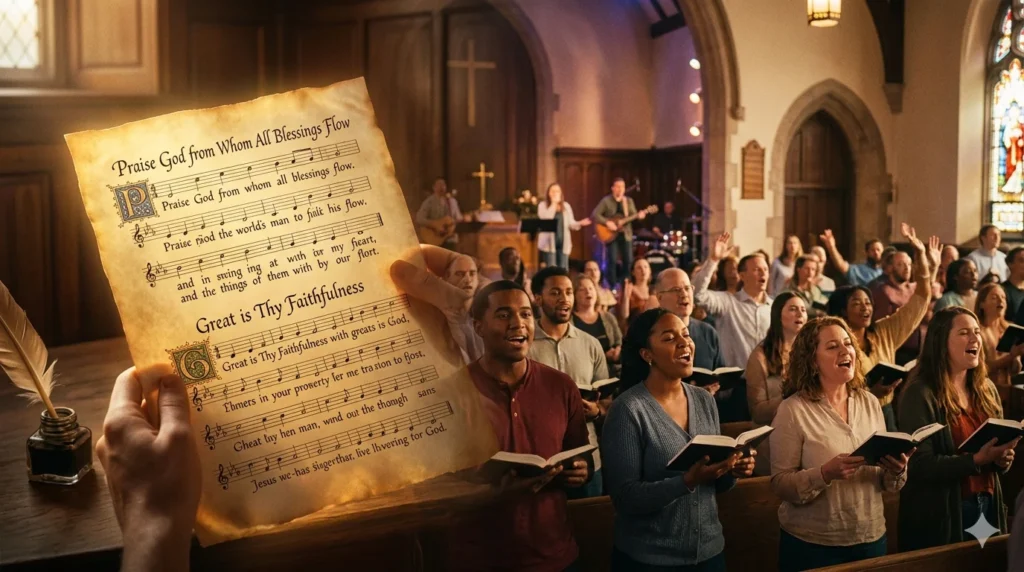
Most Americans know this hymn the moment they hear it. It is sung at offertory, at the close of worship, and at moments of deep gratitude. But many people have only ever heard one version.
The classic doxology text that most U.S. congregations sing is a single, four-line stanza. It calls all creation — every creature on earth and every angel in heaven — to offer praise to the Holy Trinity: Father, Son, and Holy Ghost.
Beyond that familiar stanza, Bishop Thomas Ken actually wrote a fuller, extended version with multiple verses. These verses speak of the Creator’s praise rising from all who dwell beneath the skies, of the Redeemer’s name being sung through every land, and of God’s eternal mercies and truth enduring forever. Most churches only sing the opening stanza today, but the complete text adds rich theological depth that is worth knowing.
Different denominations also use slightly different lyric variations. The Baptist Hymnal 1991, the United Methodist Hymnal, the Glory to God Presbyterian Hymnal, and the Evangelical Lutheran Worship each carry their own approved text. Some modern hymnals use inclusive language adaptations. The Church of Jesus Christ of Latter-day Saints Hymnal (#242) also includes it. The hymn has even been translated into Spanish (“A Dios el Padre celestial”), Hawaiian (“Ho’onani i ka Makua mau”), Korean, German, French, and over a dozen other languages — appearing in more than 1,446 hymnals worldwide according to Hymnary.org.
That is a reach no other four-line hymn can match.
Who Wrote “Praise God from Whom All Blessings Flow”? — The Story of Bishop Thomas Ken and the OLD HUNDREDTH Tune
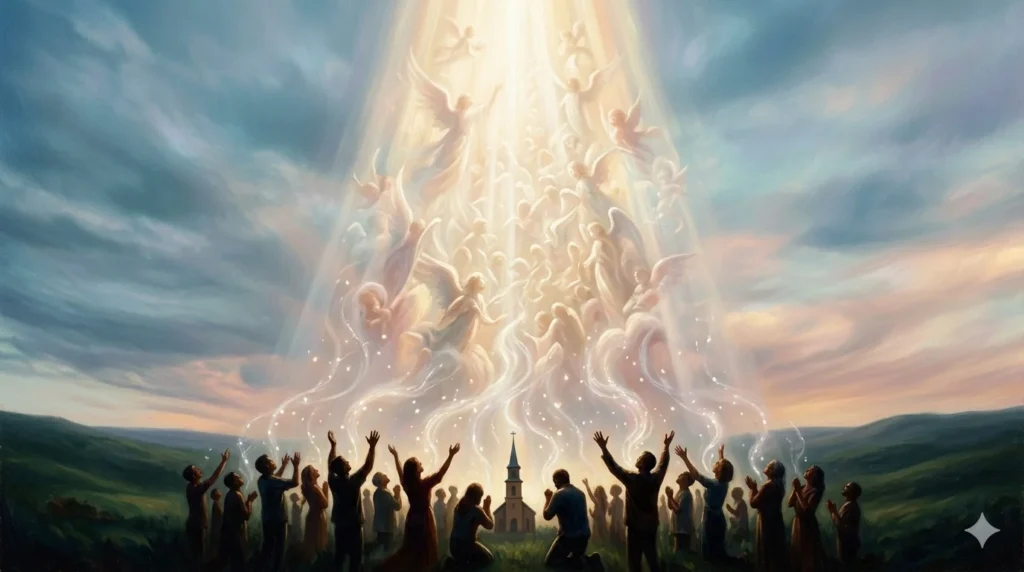
This is where most blogs stop short. The history behind this hymn is far more compelling than people realize.
Thomas Ken was born in Berkhamsted, Hertfordshire, England in 1637. He studied at Winchester College and Oxford, was ordained in the Church of England in 1662, and eventually became the Bishop of Bath and Wells in 1685.
Ken was a man of extraordinary moral courage. When King Charles II visited Winchester and expected lodging to be provided for his mistress, the actress Nell Gwynne, Ken refused. According to historical accounts, he quickly declared his house under repair — and had a builder remove the roof — just to avoid the situation. Remarkably, King Charles II later respected Ken for his conviction and appointed him bishop.
In approximately 1674, Ken wrote three hymns — for morning, evening, and midnight — intended for the scholars of Winchester College. Each hymn ended with the same closing stanza of praise to the Trinity. That stanza became what we now call the Doxology. It was first published in pamphlet form in 1694 and formally included in Ken’s A Manual of Prayers for the Use of the Scholars of Winchester College in its 1695 edition.
The tune it is sung to — OLD HUNDREDTH — has an equally rich history. It is attributed to Louis Bourgeois, who edited the Genevan Psalter of 1551 in Geneva, Switzerland. The tune became connected to William Kethe’s paraphrase of Psalm 100 in the Anglo-Genevan Psalter of 1560 — and that is where the name “Old Hundredth” comes from. It is sometimes also called SAVOY or Genevan 134.
Why is Isaac Watts sometimes credited? Isaac Watts (1674–1748) was a prolific hymn writer and a Congregationalist — not the author of this doxology. Some expanded or combined versions of the hymn incorporate Watts-adjacent texts, and because Watts is so associated with English hymnody, the confusion persists. But the doxology itself belongs entirely to Thomas Ken.
What Does “Praise God from Whom All Blessings Flow” Mean? — Line-by-Line Breakdown
This is the section most lyrics sites completely ignore — and it is exactly what American readers searching for deeper meaning need.
“Praise God from whom all blessings flow”
This opening line is a direct theological statement. Every good thing — health, family, grace, salvation — originates from God alone. The Bible confirms this clearly. James 1:17 states that every good and perfect gift comes down from the Father above. Ephesians 1:3 describes God as the one who has blessed believers with every spiritual blessing. The line is not a suggestion. It is a declaration of divine sourcing — God is the origin point of all blessing.
“Praise Him, all creatures here below”
This is a universal call. It does not address just Christians, just Americans, or just church members. It addresses all creatures — every living being beneath the sky. This echoes Psalm 148, which calls on everything from angels to sea creatures to mountains to rivers to praise the Lord. Ken understood that praise is not a private act. It is a cosmic one.
“Praise Him above, ye heavenly host”
The heavenly host refers to the angels — the divine assembly of spiritual beings who surround God’s throne. Isaiah 6:1–4 and Revelation 4:8–11 both describe this scene: angelic beings declaring God’s holiness without ceasing. Ken connects earthly worship to this eternal heavenly chorus. When a congregation sings this line on a Sunday morning, they are joining something far larger than themselves.
“Praise Father, Son, and Holy Ghost”
The final line is a Trinitarian confession compressed into seven words. It names all three persons of the Godhead — Father, Son (Jesus Christ the Redeemer), and Holy Ghost (the Spirit). This is why the doxology serves as a theological summary of the Christian faith. Romans 11:36 captures the same idea: from Him, through Him, and to Him are all things.
In just 28 words, Thomas Ken constructed a complete statement of Christian belief, universal praise, and Trinitarian worship. That is why it has never needed revision. It was right the first time.
Must Visit: 150 Happy Sunday Blessings, Quotes, Prayers, Wishes & Images to Brighten Your Week
How and When Is the Doxology Sung in American Churches Today?
The Doxology is one of the most-used pieces of music in American Christian worship — across virtually every Protestant tradition and many Catholic settings.
It is most commonly sung at the offertory — the moment when the congregation presents its financial gifts. The logic is deeply intentional: before money is received, the church pauses to acknowledge that everything already belongs to God. Giving is an act of returning what was never ours to begin with.
Which denominations sing it? According to Hymnary.org, the hymn appears in hymnals used by Presbyterians, Baptists, Methodists, Lutherans, Anglicans, Catholics, Moravians, Mennonites, and the African Methodist Episcopal Church, among others. It is truly ecumenical — no single tradition owns it.
In the Baptist Hymnal 1991, it appears as #253. In the United Methodist Hymnal, it is #95. The Glory to God Presbyterian Hymnal places it at #606. The Evangelical Lutheran Worship carries two versions — #884 and #885. The Lutheran Service Book lists it at #805.
Modern arrangements have expanded its reach further. Contemporary settings, SATB choral arrangements, handbell versions, piano improvisations, and even orchestral settings exist. Composers like Cindy Berry have woven the doxology text into larger original works. Some churches use it as a call to worship. Others close every service with it. In some congregations, it is sung every single Sunday — week after week, year after year.
That kind of repetition is not monotony. It is formation.
FAQs
Is there a Bible verse that says “Praise God from whom all blessings flow”?
No single Bible verse uses that exact phrase. However, the meaning draws directly from several scriptures. James 1:17 teaches that every good and perfect gift comes from God the Father. Ephesians 1:3 speaks of God blessing believers with every spiritual blessing. Psalm 100 calls all the earth to praise God. The doxology is a poetic synthesis of these biblical truths — not a direct quotation, but a faithful reflection of scripture’s teaching on God as the ultimate source of all blessing.
What is the song that starts with “Praise God from whom all blessings flow”?
The song is called the Doxology. Its full title is “Praise God, from Whom All Blessings Flow.” It was written by Bishop Thomas Ken around 1674 as the closing stanza of his morning and evening hymns for Winchester College. It is set to the tune OLD HUNDREDTH, composed by Louis Bourgeois for the Genevan Psalter of 1551. Today it is one of the most recognized pieces of sacred music in the English-speaking world.
What are the words of the Doxology?
The standard version sung across most American Protestant churches is a four-line stanza calling all creation to praise God — on earth and in heaven — and concluding with a declaration of praise to the Father, Son, and Holy Ghost. Extended versions include additional verses about the Creator, the Redeemer, and God’s eternal mercy and truth. Exact wording varies slightly by denomination and hymnal edition.
Who wrote the Doxology “Praise God from whom all blessings flow”?
Bishop Thomas Ken (1637–1711) wrote it. He was an Anglican clergyman and Bishop of Bath and Wells in England. He composed it around 1674 as the final stanza of three hymns written for the students of Winchester College. It was published in 1694 and has been in continuous use ever since — appearing in over 1,446 hymnals globally.
What religion was Isaac Watts?
Isaac Watts (1674–1748) was a Congregationalist — a branch of English Nonconformist Christianity. He is widely regarded as the “Father of English Hymnody” and wrote iconic hymns such as “Joy to the World” and “When I Survey the Wondrous Cross.” However, he did not write the Doxology. That is a common misconception. The Doxology was written by Thomas Ken, an Anglican bishop.
What religion sings the Doxology?
The Doxology is sung across a wide range of Christian denominations. These include Presbyterian, Baptist, Methodist, Lutheran, Anglican, Episcopal, Catholic, Moravian, Mennonite, and Reformed congregations. It also appears in Latter-day Saints and African Methodist Episcopal hymnals. Because its text is purely Trinitarian and non-denominational in structure, it has been embraced by virtually the entire Protestant world — and beyond. It is one of the few hymns that genuinely crosses all theological boundaries within Christianity.
Why “Praise God from Whom All Blessings Flow” Has Lasted 350+ Years
Some hymns age. This one has not.
Twenty-eight words. That is all Thomas Ken needed to write something that has outlasted kingdoms, denominations, theological debates, and musical trends. The Doxology endures because it does not argue. It does not explain. It simply declares.
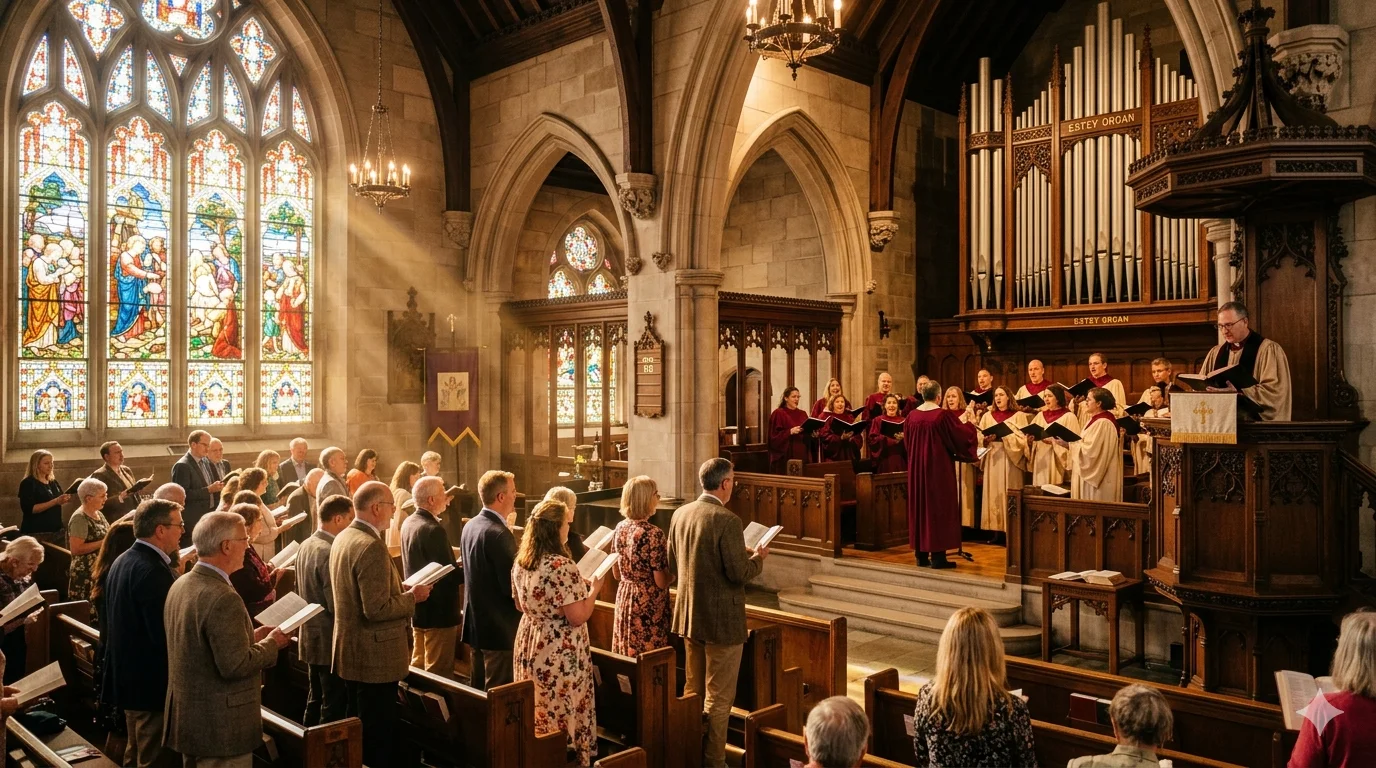
It traveled from a Winchester College chapel in 17th-century England to nearly every American church tradition — Presbyterian congregations in New England, Baptist churches in the American South, Methodist sanctuaries in the Midwest, and Lutheran assemblies across the Great Plains. It crossed the Atlantic and never lost its power.
Worship leaders today still choose it because it does something few modern worship songs can do in under 30 seconds: it reminds an entire congregation, all at once, that God is the source, God is the sustainer, and God alone deserves praise. In an era of lengthy worship sets and complex production, that kind of simplicity is not a weakness. It is a superpower.
The OLD HUNDREDTH tune is equally timeless. Its four strong, equal phrases feel like pillars. Even someone hearing it for the first time senses its weight. And someone who has sung it for 60 years still feels something move inside them when the organ opens up and the congregation rises.
“Praise God from whom all blessings flow — because every good thing in your life has a source, and that source has a name.”
This is not just a hymn for Sunday mornings. It is a posture. A reminder that gratitude is not optional for the believer — it is foundational.
Whether your church sings it every week or only on special occasions, “Praise God from Whom All Blessings Flow” belongs to all of us. It always has.