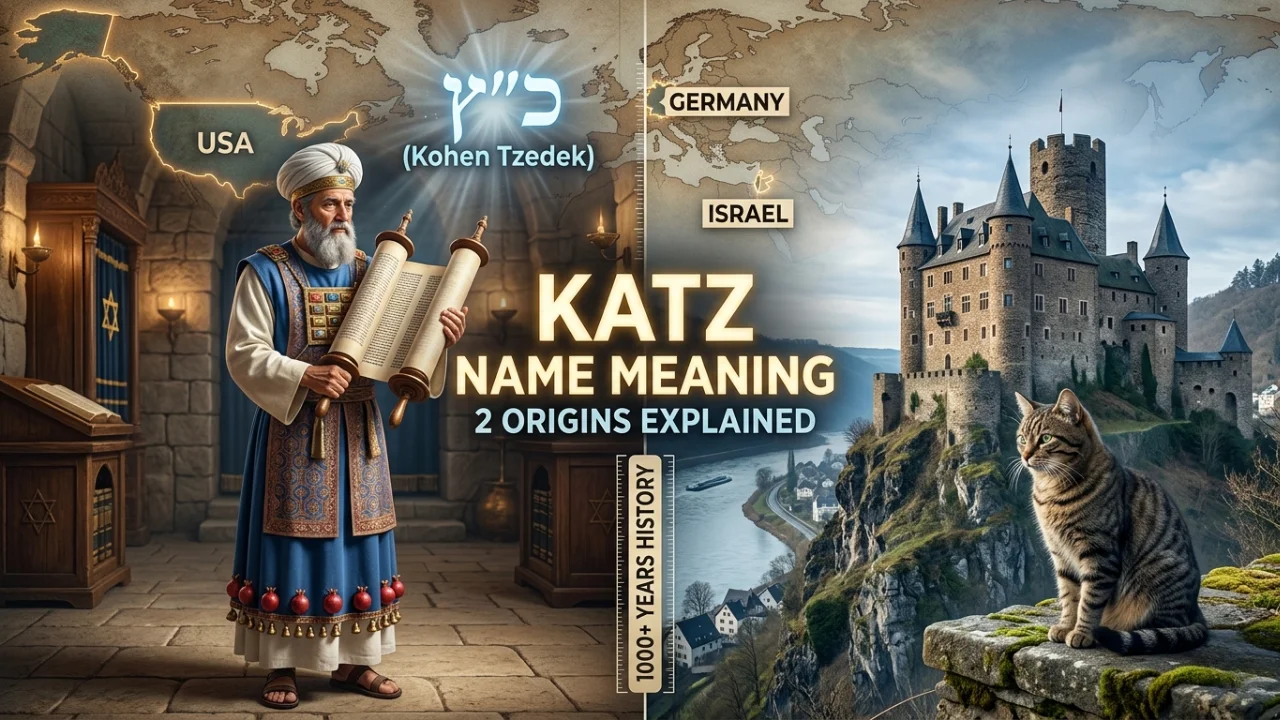
Four letters Katz meaning. One surname. And a history that stretches back over a thousand years.
The name Katz is not just a last name — it’s a living historical record encoded in two simple letters of the Hebrew alphabet. For millions of people across the USA, Israel, Germany, and beyond, this surname carries deep roots in Jewish priestly lineage, ancient scripture, and Germanic geography.
What Does Katz Mean? The Two Distinct Origins Behind the Name
Most people assume Katz simply means “cat.” That’s partially true — but it tells only half the story. The Katz surname actually has two completely different origins depending on whether the bearer is of Ashkenazi Jewish or German descent.
The Hebrew Origin — Kohen Tzedek (כהן צדק)
Quick Answer: For Ashkenazi Jews, Katz is a Hebrew acronym for Kohen Tzedek (כּ״ץ), meaning “Priest of Righteousness” or “Priest of Justice.”
In Jewish naming tradition, Katz is formed from the first letters of two Hebrew words: Kohen (כּ) meaning priest, and Tzedek (ץ) meaning righteousness or justice. The tiny mark between them — called Gershayim (ʺ) — signals it’s a Hebrew abbreviation.
This connection to priestly identity is not accidental. The term Kohen Tzedek appears directly in Psalm 132:9: “Let thy priests be clothed with righteousness (tzedeq).” Some scholars also link it to Melchizedek from Genesis 14:18 — described as both “king of righteousness” and “priest of the most high God.”
People carrying the Katz surname traditionally belong to the Kohanim — the Jewish priestly class descended from Aaron the brother of Moses. This lineage came with real responsibilities in synagogue life: the first Torah reading, the recitation of the Priestly Blessing (Birkat Kohanim), and a position of religious honor.
There is also a specific tradition tracing the name to Tzadok — the first High Priest to serve in King Solomon’s Temple (2 Samuel 15:24). Some historians believe the original phrase may have been Kohen Tzadok before evolving into the more widely used Kohen Tzedek.
The German Origin — Katze (Cat)
When Katz appears as a purely German surname, it typically derives from the German word Katze, simply meaning “cat.” However, even this path has deeper layers.
The famous Katz Castle (Burg Katz) on the Rhine River is a well-known example — but its name does not actually come from Katze directly. It traces back to Katzenelnbogen, which itself derives from the Latin compound Cattimelibocus — built from two ancient Germanic tribal names: the Chatti tribe and Melibokus.
Additionally, many families with the longer surname Katzenelenbogen shortened it to Katz when they immigrated to America — making the name both a tribal abbreviation and a practical simplification.
Key Distinction: Jewish Katz = Hebrew priestly acronym. German Katz = cat / geographic/tribal origin. Same spelling — entirely different roots.
Must Visit: Bomboclat Meaning: Origins, Usage, and Cultural Significance
The Ancient History of the Katz Surname — How Old Is It Really?

Ripley’s Believe It Or Not! once declared Katz one of the oldest surnames in recorded history. That claim deserves a closer look — because the documented evidence is genuinely remarkable.
A Documented Timeline of the Katz Name
917–922 CE — Kohen Tzedek Kahana ben Joseph serves as the Gaon of Pumbedita, one of the most prestigious leadership positions in the Jewish world. His name uses the full form Kohen Tzedek — the root of all Katz surnames.
960–968 CE — His son, Nehemiah ben Kohen Tzedek, follows him as Gaon — continuing the name across another generation.
1536 CE — The Hebrew abbreviation כּ״ץ appears on a tombstone in Prague. This is the earliest confirmed use of the shortened Katz form. (Source: Hock, Die Familien Prag’s, p. 175)
1618 CE — The same abbreviation appears on a Frankfurt tombstone (Horowitz, Die Inschriften des Alten Friedhofes, p. 63)
1600s — Found in the books of the Soncino family of Prague — a family of prominent Jewish printers and scholars.
1663 CE — Appears in the preface to Shabbethai ben Meir haKohen’s commentary on the Choshen Mishpat, published in Amsterdam.
The full Germanicized spelling “Katz” became especially widespread in the 18th and 19th centuries when German authorities formally required Jewish communities to adopt permanent surnames. Many chose to formalize their priestly identity in writing — and Katz became the standard form.
For context: O’Brien is often cited as the world’s oldest documented surname, traced through the Annals of the Four Masters (1632–1636, Ireland). Katz, by contrast, traces its full form back nearly seven centuries earlier — to 10th-century Babylonian Jewish leadership.
Katz Name Meaning and Its Deep Connection to Jewish Priestly Heritage
Understanding the Katz surname meaning requires understanding what it meant to be a Kohen in Jewish history. This isn’t just a genealogical footnote — it’s a living identity.
The Kohanim were not simply religious officials. They were the designated guardians of the Temple service, tasked with offering sacrifices, blessing the people, and maintaining the sacred laws of purity. Descended from Aaron, they carried a hereditary religious role that persisted even after the Temple’s destruction in 70 CE.
In synagogues to this day, a Kohen is called first to the Torah reading — a tradition directly tied to this ancient hierarchy. Families with the Katz surname have historically been identified as belonging to this priestly class.
The alternate spelling Catz is phonetically and historically identical — simply a regional or scribal variation. Both forms carry equal weight in terms of Ashkenazi Jewish genealogy and priestly heritage.
It’s worth noting an important nuance: not every person named Katz is a confirmed descendant of the Kohanim. Over centuries, the name spread beyond strictly priestly families, particularly as surname adoption became legally required. But the origin — and the weight of meaning — remains rooted in that priestly designation.
Katz Name Meaning Across the Globe — Distribution and Modern Usage
Today, the Katz surname is found on every continent. According to data from Forebears.io, here is how the name is distributed worldwide:
| Country | Estimated Bearers |
| 🇺🇸 United States | ~52,154 (+ 334 spelling it Catz) |
| 🇮🇱 Israel | ~17,219 |
| 🇩🇪 Germany | ~4,589 |
| 🇨🇦 Canada | ~2,769 |
The United States has the largest concentration of Katz bearers globally. This is directly tied to the massive waves of Ashkenazi Jewish immigration from Eastern Europe and Germany between the 1880s and 1940s. Many families arrived with this surname already in place — or formalized it upon arrival.
In Israel, the name carries proud priestly significance. In Germany, bearers may come from either Jewish or purely Germanic roots. In the USA, genealogical databases like FamilySearch and Ancestry.com list thousands of Katz family trees — making it one of the more actively researched surnames in Jewish-American genealogy.
Notable People Named Katz
Alex Katz (born 1927) — Celebrated American artist known for bold figurative painting. His work is held in the Museum of Modern Art (MoMA).
Bernard Katz (1911–2003) — German-born British biophysicist. Won the Nobel Prize in Physiology or Medicine in 1970 for research on nerve signal transmission.
Vera Katz (1933–2017) — American politician who served as Mayor of Portland, Oregon.
Mickey Katz (1909–1985) — American comedian and musician celebrated for his Yiddish-language parody recordings.
Sandor Katz (born 1962) — American food writer and fermentation activist, widely respected in the natural foods movement.
It’s also worth noting that Katz is a gender-neutral name. While predominantly a surname, it has been used occasionally as a given name in modern American contexts.
FAQs
Q: What does Katz mean?
Katz most commonly means “Priest of Righteousness” — a Hebrew acronym for Kohen Tzedek (כּ״ץ) used as a Jewish surname. As a German surname, it can also mean “cat” from the German word Katze.
Q: What is Katz short for?
In Jewish tradition, Katz is short for Kohen Tzedek — meaning “righteous priest.” It can also be a shortening of the longer German surname Katzenelenbogen, often simplified upon immigration to America.
Q: What does Katz mean in English?
In English, Katz translates to “Priest of Righteousness” from its Hebrew origins. From its German roots, it translates to “cat” — derived from Katze.
Q: What does the name Katz mean?
The name Katz carries a dual meaning: in Jewish heritage it signifies priestly lineage and righteousness. In German heritage it refers to a cat or traces back to ancient Germanic tribal geography along the Rhine River.
Q: Is Katz a Russian name?
Katz is not originally a Russian name. It is an Ashkenazi Jewish and German surname. However, many Katz families lived in Russia and Eastern Europe for generations as part of the Jewish diaspora — which is why the name is historically associated with that region.
Q: What is a cute German cat name?
While Katz itself means cat in German (Katze), popular cute German cat names include: Minka, Kätzchen (little cat), Schnurri (the purrer), Mietze, and Bello — all rooted in warm, affectionate German pet naming traditions.
Conclusion
Few surnames carry as much layered meaning as Katz. On one side, it is a sacred Hebrew acronym encoding over a thousand years of priestly identity, biblical scripture, and Jewish communal history. On the other, it is a German geographic name tied to ancient tribal roots along the Rhine.
If you carry this name — or are researching it — resources like FamilySearch.org, Ancestry.com, and Forebears.io are excellent starting points for tracing your specific Katz family line.